

My social media algorithm, aware of my interest in vintage period products, served me several videos by popular vintage content creator Jasmine Chiswell featuring a “100-year-old pad.” In the opening scene, she holds a product I had come across many times while scrolling eBay – a diamond-shaped box that sellers describe as a “very rare vintage sanitary napkin.” The packaging is clearly old, marked by beautiful script reading “Dr. Pierre’s Hygeiaforms.”
I first bookmarked the item in 2024 after spotting it from an eBay seller known for listing extremely old period care products. The tiny box had no photos of the product inside, so I set it aside with plans to research it eventually. Then Jasmine Chiswell’s videos appeared in my feed in 2026. The video showing Jasmine dripping water onto this oddly shaped pad caught my attention. Her videos about this product collectively drew over 100 million views. That level of interest finally pushed me to dig in.
What Google Says
A quick Google search returned very little – mostly product listings. Worthpoint, a site that archives old eBay listings and sale prices, described Hygeiaforms as a sanitary napkin. An AbeBooks listing with the item currently for sale used the same language. A website called “Eclectibles” included Hygeiaforms in a catalog alongside a note about the “pink tax” for women who buy period products. One eBay listing sold just the empty box. The lone exception was “The Old Operating Theater,” a museum in London with a box on display. They did not call it a sanitary napkin, and they cite the right source, but it’s included in a post all about vintage pads.
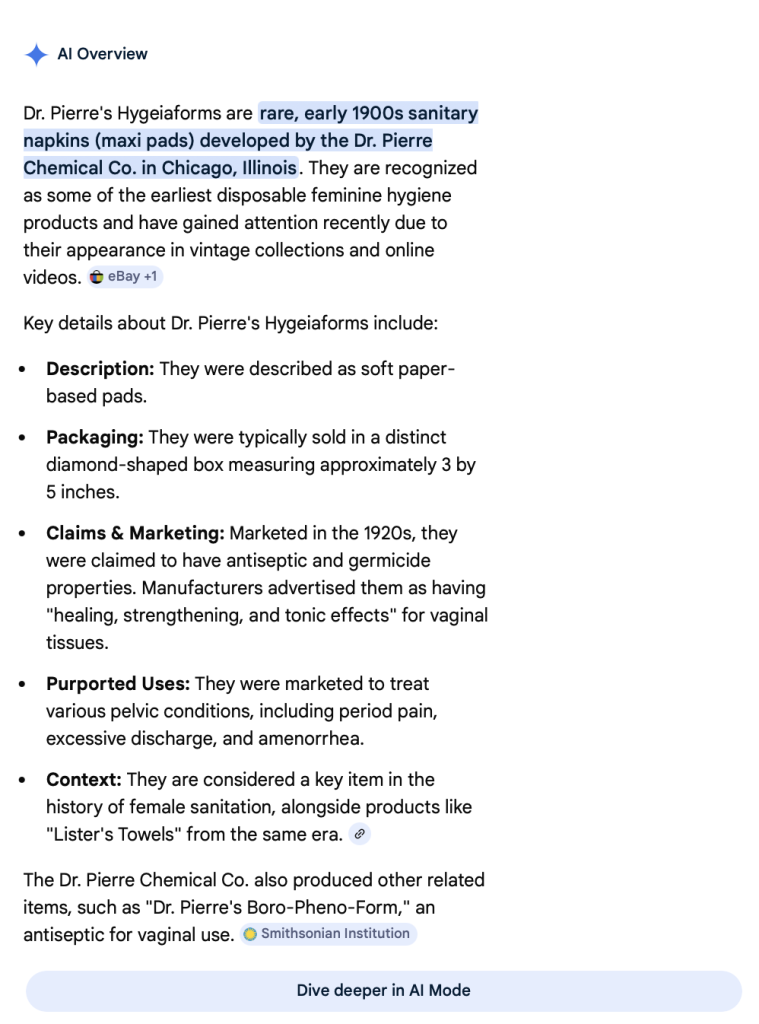
Google AI pulled from all of those listings and assembled a concise summary – concluding that Hygeiaforms are sanitary napkins. AI also conflated the real description and folded it into the false claims about it being a sanitary napkin. Jasmine Chiswell drew the same conclusion in her research. But Hygeiaforms are not sanitary napkins.
What Hygeiaforms Actually Were
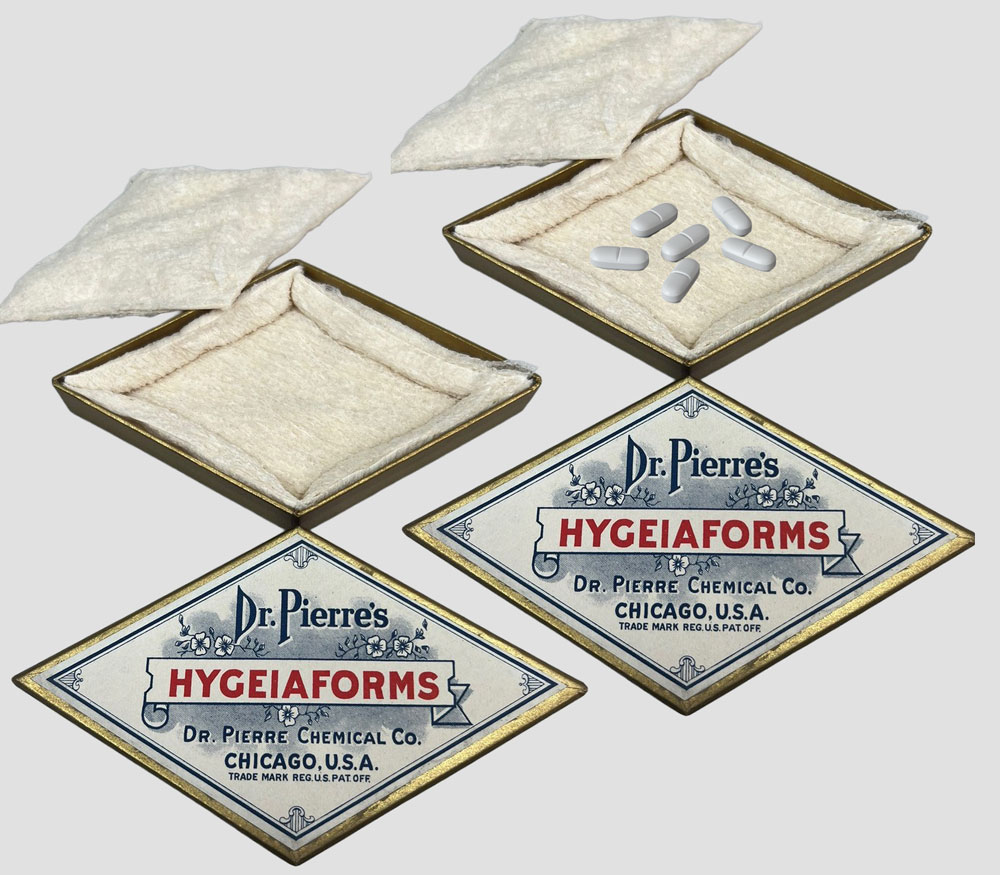
Hygeiaforms were tablets. The fluffy batting-like material inside the box was cushioning – lining the bottom, sides, and top of the packaging to keep the tablets from breaking in transit. Once you know the truth, the misidentification becomes almost obvious. Why would a company called Dr. Pierre’s Chemical Co. manufacture a menstrual pad? Why would one pad come packaged in such an ornate individual box? Why would it arrive so tiny, in two pieces, in a diamond shape – the opposite shape from the area between the legs? How would this pad be used with a sanitary belt, the only way to hold napkins in place in the 1920s. The pieces click into place the moment you look past the first page of Google results.
The Primary Source: A 1932 Government Record
The answer came from the Internet Archive. A 1932 U.S. government publication – Notices of Judgment Under the Food and Drug Act – records a legal case brought against Dr. Pierre’s Chemical Co. on pages 356–357. The U.S. Attorney filed against the company for libel and seized 11 boxes. The charges were adulteration and misbranding in violation of the Food and Drug Act.
The record makes the product’s true nature clear. Hygeiaforms were tablets used to create an antiseptic solution: “An antiseptic solution is obtained by dissolving and mixing one Hygeiaforms tablet in a quart of water.”
The company’s own circular, quoted directly in the judgment, described the intended uses:
“Hygeiaforms are actually beneficial because of their healing, strengthening, and tonic effects on the most delicate tissues… We earnestly urge all women so afflicted to use Dr. Pierre’s Hygeiaforms. As a tonic and invigorator in Nervous Debility, use one every other night. For Leucorrhea, Catarrh, Prolapse, Version, Flexion, Backache, Suppression of the Natural Flow due to a cold, and as a general tonic to any of the Female Organs, use one every other night with an injection of warm water.”
The solution was likely applied topically or used as an antiseptic douche. Using cleansers to douche was popular in the 1920s. The circular described the mechanism: “antiseptic action which cleanses the parts and destroys pus cells… by its slight astringent properties which tend to restore the dilated Epithelial cells to their normal size.”
How the Internet Got It Wrong
The misidentification almost certainly traces back to a single eBay listing. A recent listing from a seller of vintage products listed the empty box – still containing the two pieces of diamond-shaped cushioning – with the title: “Early 1900’s Dr. Pierre’s Hygeiaforms Sanitary Napkin – Vintage Feminine Hygiene.”
The item description read:
“Rare And Key Early 1900’s Dr. Pierre’s Hygeiaforms Sanitary Napkin, Early Maxi Pad. These are some of the earliest known feminine pads, and have become famous because of recent videos on YouTube and TikTok. The only ones on eBay, Extremely Rare Vintage Feminine Hygiene!”
That listing, pricing Hygeiaforms at the very affordable price of $999.99 plus $50 shipping, has been live since 2024. Update: The seller of this particular item has removed the listing after many people reached out about the inaccuracy. He informed me that he’s selling the boxes on behalf of someone else who saw another earlier eBay listing calling them sanitary napkins, and he ran with that description.
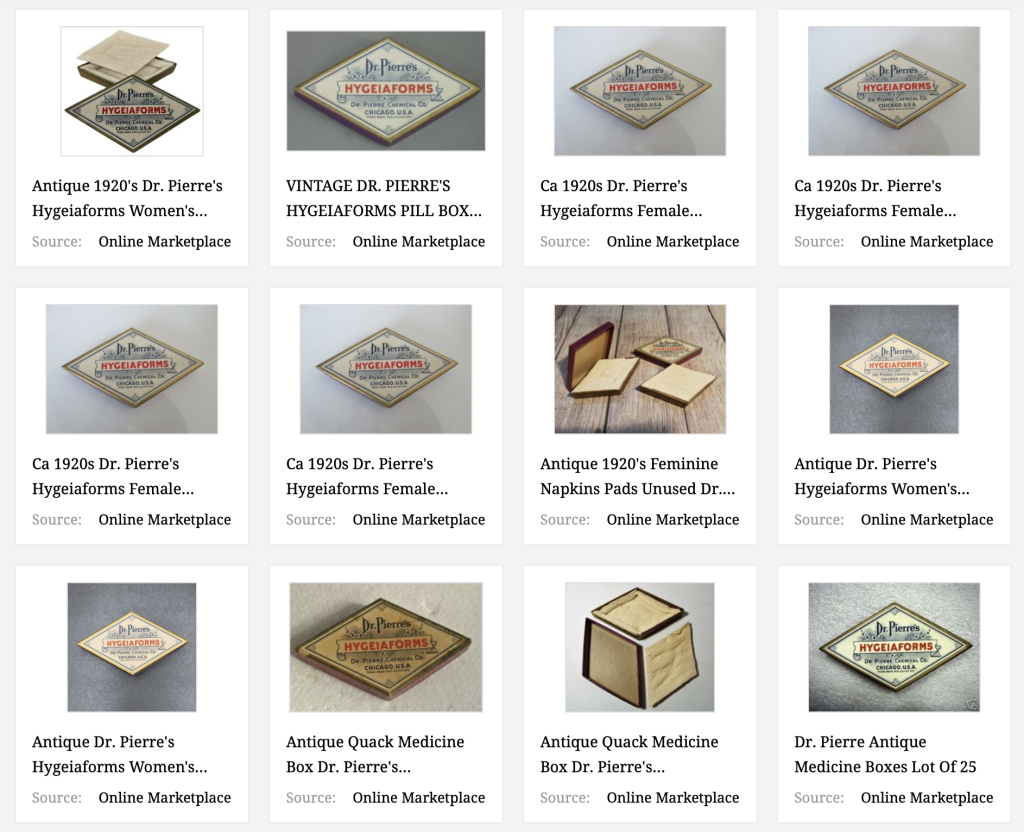
The “early feminine hygiene” characterization is accurate – the product did market itself as a remedy for period-related ailments. But at some point a seller likely mistakenly identified the interior cushioning/batting as the product itself, concluding the box held a single sanitary napkin. That one listing set the definition for other eBay sellers, landed in Worthpoint’s archive, and repeated across other platforms until it became the accepted answer.
The only front-page result to get it kind-of right was an actual museum – and that museum cited the same 1932 government record I found, however it still seems they are connecting the product to sanitary napkins. The book we both cite seems to be the only primary source either of us could locate for a product whose original purpose had almost been lost entirely.
Why This Matters
This is a mostly harmless example of how misinformation spreads online. It is also a precise illustration of why AI gets things wrong – not through fabrication, but through reproduction of bad sources. Google AI did exactly what it was designed to do. The problem is that it referenced multiple webpages stating uncited information as credible references.
Primary sources do not go out of style. Citing an eBay listing is not research.
The same seller who incorrectly listed Hygeiaforms as sanitary napkins also describes a $5,999 box of Venus Sanitary Napkins as “the oldest box.” We have those napkins – purchased from a separate listing for our museum exhibit – and they are not the oldest known box of sanitary napkins. They are, however, an excellent example of what a 100-year-old pad actually looked like. Two small diamond-shaped pieces of thin batting do not a sanitary napkin make.
Support The Menstrual Museum
If you enjoyed this article and want to see the Period Nirvana exhibit, “100 Years of Period Technology” thrive, consider making a contribution. This exhibit is self-funded and our educational content, as well as the exhibit in Asheville, is free to all. Purchase a post-card at any price $5+ and we will send it as a thank you note.
Source: Notices of Judgment Under the Food and Drug Act, U.S. Government, 1932, pp. 356–357. Available via the Internet Archive.


Leave a Comment